
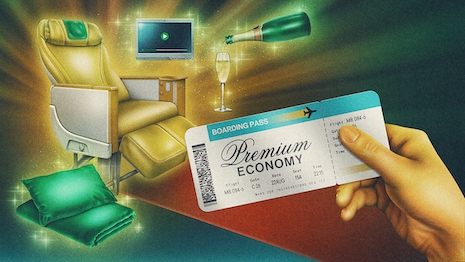
 CNT and WIRED have released part one of a first-of-its-kind digital edition on the current state of business travel. Image courtesy of Condé Nast
Condé Nast Traveler and WIRED are teaming up to explore the experiences of next-gen luxury travelers.
This summer, the two Condé Nast publications are releasing a first-of-its-kind digital edition on the current state of business travel and the increasingly interconnected relationship between work and wellness on the road; part one of the project is now live, with the second chapter launching next month. Tapping into each outlet’s editorial focus, the cross-title package explores luxury aviation, mobile work, modern design and how connectivity and tech are reshaping the sector.
In this Q&A, Angela Watercutter, senior editor of special projects at WIRED, as well as CNT’s Hannah Towey, associate editor of transportation and travel news, and Lale Arikoglu, articles director, reflect on a range of topics, including the rising standards of today’s business class passenger, the state of in-flight amenities, the pros and cons of always-on Wi-Fi and why now was the right time to launch the collaboration. Here is the dialogue:
 The cross-title package explores luxury aviation, mobile work, modern design and how connectivity and tech are reshaping the high-end travel sector. Image courtesy of Condé Nast
Based on themes explored in “For Today's Business Traveler, It's All About Work-Life Integration,” from airlines to luxury retailers, what is the biggest takeaway for brands aiming to win loyalty from this generation of business travelers, as the line between work and leisure continues to blur?
Angela Watercutter: Personally, I think the difference is in the details, the amenities, the small touches. For airlines or hotels, it might be offering a better cup of coffee or espresso, something that allows travelers to feel like they’re starting their day at a cafe in their own neighborhood.
The same holds true at night. A hotel bar or airport lounge that feels like the kind of place they’d enjoy at home can make a work trip feel like more than just a work trip.
For retailers, it’s the same. Grabbing a new suit or outfit for a client meeting needs to be an experience rather than a chore.
How are caviar services, design-forward suites and other privacy and wellness additions mentioned in “Business Class Ain't What It Used to Be” impacting flyer non-negotiables today?
Hannah Towey: Today’s business class passengers have higher standards—and they’re willing to pay more to ensure that bar is met.
The best example right now is the advent of the privacy door. Suddenly, all the new business class suites have them, so fliers are going to start expecting that at this price point.
Wealthy travelers are also prioritizing wellness much more than they used to. They want high-quality sleep and healthy in-flight meals, and are doing everything they can to avoid jet lag.
Free Champagne isn’t cutting it anymore. They want ginger turmeric shots and silk eye masks.
Is private aviation on track to become the new norm for business travelers, or will commercial still dominate for the foreseeable future?
HT: Private aviation has definitely become more mainstream post-COVID for a select clientele of travelers, especially as more affordable “semi-private” carriers like Aero and JSX expand their route maps. But it’s still an inaccessible price point for the vast majority of travelers.
So it may become the new norm for the C-Suite or tech founders, for example, but the average business traveler will still fly commercial.
Are we approaching a point of no return where full connectivity, calls and/or video meetings included, is expected onboard, or do most business travelers still prefer to unplug at 35,000 feet as Wi-Fi becomes both faster and free, per “Airplane Wi-Fi Is Now… Good?”
Lale Arikoglu: This has been a hot topic at Condé Nast Traveler of late, with editors divided on whether the convenience of full wi-fi access at 35,000 feet, as most airlines now promise and mostly deliver, removes one of the last remaining sacred spaces where we aren't expected to be connected to our phones at all times—especially when work is concerned.
Clearly the demand for full connectivity is there among travelers: As Wired reported for this package, “Delta has spent more than $1 billion bringing free wi-fi to its customers” although the airline was also quick to point out that, for a lot of business travelers, a long transatlantic flight is maybe the one opportunity to disconnect amid a hectic schedule.
Sure, in-flight wi-fi has never been better, but I suspect most of us are secretly quite happy when that screen refuses to load and we're given a brief reprieve from the incessant notifications of our daily lives.
Regarding the editorial partnership, why WIRED and CNT, and why now for the delivery of this digital edition? What can readers expect from part two of the collaboration?
AW: At WIRED, we’re experts on the future—and the ways that technology can lead us there. Our colleagues at Condé Nast Traveler are specialists in what it takes to turn a trip into a journey.
Five years ago, business travel slowed to a near halt during the Covid-19 pandemic. Now, it’s back and travelers seem keen to make it something different or better than it was.
This summer marked the perfect time for WIRED and Traveler to team up to give readers a guide to what work trips look like in 2025. Readers can expect more of that in the second part of this collaboration.