
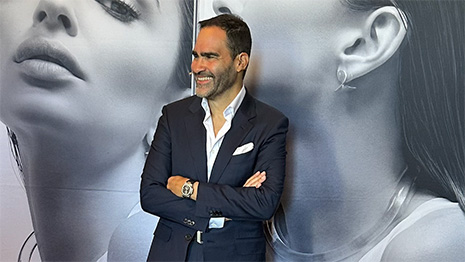
 Daniel Langer is the founder and CEO of consulting firm Équité
Luca de Meo may be the most important appointment in luxury in a decade.
Not because of the speed of his restructuring at Kering, though it has been impressive. What makes de Meo consequential is what he sees that most luxury leaders do not.
In a recent interview, he said something that should be studied by every executive in the industry: the total luxury sector is worth 350 billion euros, and the area in which Kering is strong covers only 20 percent of it. 80 percent remains open.
That is not a market share observation. It is a strategic declaration.
De Meo is not interested in simply optimizing Kering's existing position. He wants to build an entirely different company, one that captures territory the group has never occupied.
He has done this before. At Renault, de Meo inherited a company bleeding 8 billion euros in losses.
His response was not to restructure first. It was to define what Renault meant.
"Renaulution" was a brand story that gave every operational decision a creative anchor. "Alpine" became the emotional pinnacle.
"Dacia" became the radical value play. Every brand had a clear reason to exist.
The operational discipline followed, but meaning came first. Eighteen months later, Renault was profitable again.
That sequence is what made de Meo exceptional. The question facing Kering is whether that same sequence will prevail.
It must. Because the 20 percent Kering currently occupies is on fire.
Gucci has posted ten consecutive quarters of massive decline, erasing a decade of growth and returning revenue to levels last seen around 2016.
Operating income has been cut by more than half. The global luxury market grew in the same period.
This is not a market problem. This is a meaning problem.
In its most successful eras, Gucci stood for maximalism, provocation and radical self-expression. It was a brand that gave its clients permission to be unapologetically themselves.
Then it walked away from that meaning. What it stands for today is confusion.
The lesson is precise: when a brand distances itself from the meaning it created, it does not evolve. It alienates the clients who believed in what it was.
Balenciaga has never recovered from its 2022 advertising scandal. Operating profit collapsed from nearly 300 million euros to under 45 million.
Revenue dropped from 1.4 billion to 1.17 billion euros. The brand pivoted from provocation to heritage tailoring, a strategic retreat that was necessary but insufficient.
Returning to craftsmanship is a correction, not a vision. Balenciaga knows what it is running from; it has not yet defined what it is running toward.
Bottega Veneta was once considered the most luxurious brand in the world: no logos, pure craft and radical discretion. Then it chased fast growth, launched flashy items, expanded distribution and diluted the exclusivity that made it singular.
The recent return to its core has produced modest stabilization, low single-digit growth while the rest of Kering contracted. But stabilization is not cultural influence.
Bottega Veneta has beautiful products. It does not yet have a piece with the cultural permanence and cross-generational desire of a Birkin.
Without that, craft remains admirable rather than irresistible.
These are not three separate problems. They are the same problem expressed three ways: meaning that was either abandoned, never fully built, or diluted through growth.
This is precisely the problem that will determine whether de Meo’s 80 percent vision succeeds or fails.
The history of luxury is littered with brands that saw adjacent territory, expanded toward it and destroyed themselves in the process. Not because the opportunity was wrong, but because the brand foundations were not clear enough to stretch.
The brands that have expanded successfully share one trait: they defined their emotional territory with such precision that every new category felt inevitable rather than opportunistic. That precision is rare.
It requires a rigor most luxury houses have never undertaken, because rising demand made it unnecessary. Demand is no longer rising indiscriminately.
Clarity of meaning is the foundation. Translating that meaning into desire across every product, every price point, every client interaction is the execution.
The industry's deeper crisis is not that brands lack strategy. It is that too many brands have optimized themselves into interchangeability, producing products that are commercially sound, data-validated and completely devoid of emotional charge.
No amount of consumer research produces desire. Desire is created.
De Meo’s 80 percent ambition, from new investment vehicles to wellness partnerships to services for ultra-high-net-worth clients, is the most exciting strategic vision in luxury today.
Capturing it demands that every brand in the Kering portfolio first answer a question that the industry has avoided for a decade of easy growth: what do we mean? Not what do we sell.
Not what is our heritage. What do we make people feel, and why is that feeling ours and nobody else's?
That clarity is the prerequisite for everything. De Meo has the mandate, the outsider instinct and the track record to drive it. The opportunity is vast.
Producing that clarity is a kind of work that the luxury industry's traditional toolkit was never built to deliver.
Luxury Unfiltered is a weekly column by Daniel Langer. He is the CEO of Équité, a global luxury strategy and creative brand activation firm, where he is the advisor to some of the most iconic luxury brands. He is recognized as a global top-five luxury key opinion leader. He serves as the executive professor of luxury strategy and pricing at Pepperdine University in Malibu and as a professor of luxury at New York University, New York. Dr. Langer has authored best-selling books on luxury management in English and Chinese and is a respected global keynote speaker.
Dr. Langer conducts masterclass management training on various luxury topics around the world. As a luxury expert featured on Bloomberg TV, Financial Times, The New York Times, Forbes, The Economist and others, Mr. Langer holds an MBA and a Ph.D. in luxury management and has received education from Harvard Business School. Follow him on LinkedIn and Instagram, and listen to his Future of Luxury Podcast.