
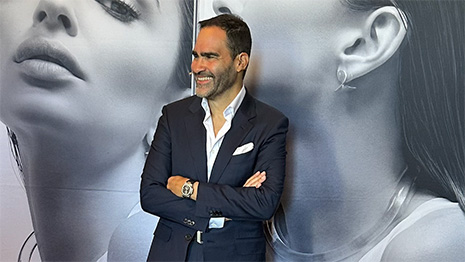
 Daniel Langer is the founder and CEO of consulting firm Équité
Here is what nobody in the luxury industry wants to talk about: most brands have no idea who their client actually is.
They know their clients when the mood is right, the location is beautiful and the purchase feels effortless — shopping on holiday or browsing after a business dinner. They do not know their clients when their portfolios have contracted by 15 percent, and they are questioning every purchase over $500, sitting at home, uncertain about the future, scrolling past the brand’s Instagram without stopping.
The relationship was never with the person; rather, it was with the mood, and the mood always changes. This is the underlying fragility of the luxury industry that no earnings call will acknowledge.
The luxury industry model, for most brands, is built on context.
The right storefront in the right city. The right tourist in the right terminal.
The right algorithm surfacing the right product at the right moment. Remove any piece of that context and the sale disappears, because the brand never created a reason to buy that existed independent of circumstance.
Any disruption that changes the context in which the client encounters the brand will reveal whether the relationship was real or whether it was simply proximity dressed up as loyalty.
Most luxury brands have CRM systems filled with data: purchase histories, spending frequencies, product preferences and average transaction values.
They can tell you what a client bought, where she bought it and when. They cannot tell you why.
They cannot tell you what role the brand plays in her life. They cannot tell you whether she will come back when the conditions that produced the original purchase no longer exist.
They have data about transactions. They have no understanding of the person behind them.
There is a test that every luxury CEO should run this week: call your top 20 clients. Not to sell, or to invite them to an event.
Just to talk. See how many pick up, or how many are glad to hear from you.
See how many wonder why you are calling and assume you want something. The ratio will tell you everything about whether you have a brand or a distribution channel.
The brands that will survive any disruption, whether it arrives as a geopolitical crisis, an economic downturn or a cultural shift, are the ones that have built something the data cannot capture. They have built meaning.
Their clients do not buy because the context is right. They buy because the brand answers a question about who they are.
That answer does not change when markets fall. It does not change when travel stops.
It does not change when the mood shifts from confidence to caution. It holds, because identity holds.
The mistake most leaders are making right now is treating their revenue problem as a marketing problem. Increase media spend.
Adjust the messaging. Run a campaign that acknowledges uncertainty.
Launch a new product to reignite excitement. All of these responses assume that the client relationship is intact and just needs reactivation.
For many brands, the relationship was never intact to begin with. You cannot reactivate something that never existed. You can only reveal its absence.
Here is where it gets dangerous: the brands that go quiet during a disruption, that cut training budgets, reduce client-facing investment and wait for conditions to improve, are making a permanent decision disguised as a temporary one.
Their competitors who stay present, who keep investing in the relationship, who show up when it is hard and not just when it is profitable, will take the space they vacate. That space, once taken, is extraordinarily expensive to reclaim.
History is consistent on this point. The brands that invested through the oil crisis of the 1970s, through the financial crisis of 2008, through the pandemic, outperformed for a decade afterward.
Silence during crisis is how trust is lost. Presence is how it is earned.
Consider what the best brands actually do differently. They do not treat the client relationship as a function of the retail team.
They treat it as the core strategic asset of the entire company. Every touchpoint, every communication, every product decision is filtered through a single question: does this deepen the relationship or does it extract from it?
Most brands extract. They optimize every interaction for conversion.
They measure success in transactions per visit, average order value, units per transaction. These are extraction metrics.
They tell you how efficiently you are harvesting demand. They tell you nothing about whether you are creating it.
The brands that create demand do something radically different. They invest in moments that have no immediate return.
They train their people to listen, to remember, to care about the client as a person and not as a revenue target. They build experiences that are so specific, so personal, so layered with meaning that the client could not replicate them anywhere else.
That specificity is the moat, and when disruption hits, the moat holds.
The luxury industry does not have a demand problem. Desire has not disappeared.
The human need for beauty, for craftsmanship, for meaning, for objects that anchor identity in an unstable world, is permanent. If anything, that need intensifies when everything else feels temporary.
People in uncertain times do not stop wanting. They become more selective about who deserves their “want.”
That selectivity is the filter that separates brands with real client relationships from brands that were renting attention and calling it loyalty. The brands that pass through the filter will emerge with something no amount of marketing spend can artificially create: trust.
The rest will discover, too late, that they were selling to a mood. And moods do not come back to the same place twice.
The question is not whether your clients will keep spending. They will.
The question is whether they will keep spending with you. If you do not know the answer, you do not know your client.
Luxury Unfiltered is a weekly column by Daniel Langer. He is the CEO of Équité, a global luxury strategy and creative brand activation firm, where he is the advisor to some of the most iconic luxury brands. He is recognized as a global top-five luxury key opinion leader. He serves as the executive professor of luxury strategy and pricing at Pepperdine University in Malibu and as a professor of luxury at New York University, New York. Dr. Langer has authored best-selling books on luxury management in English and Chinese and is a respected global keynote speaker.
Dr. Langer conducts masterclass management training on various luxury topics around the world. As a luxury expert featured on Bloomberg TV, Financial Times, The New York Times, Forbes, The Economist and others, Mr. Langer holds an MBA and a Ph.D. in luxury management and has received education from Harvard Business School. Follow him on LinkedIn and Instagram, and listen to his Future of Luxury Podcast.