
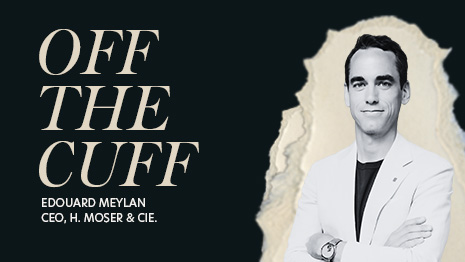
 Edouard Meylan is CEO of H. Moser & Cie.
 “Off the Cuff” is a Q&A series from Luxury Daily exploring the career paths, current projects and next steps of those shaping the world’s best luxury brands.
The interviews feature a Proust-style twist, allowing readers to get to know industry leaders on a personal level. This edition features Edouard Meylan, CEO of Swiss luxury watch brand H. Moser & Cie.
In this Q&A, Mr. Meylan discusses the winning combination of creativity and structure, celebrating heritage with new ideas and letting your mind take a real break.
Here is the dialogue:
What was your first job ever? What did it teach you?
After my engineering studies, I went into management consulting — far from the watchmaking bench, deep into corporate structure.
It taught me discipline and gave me a real framework for approaching complex problems: how to structure ideas, analyze situations and break challenges into clear steps. When I eventually moved into watchmaking, I realized how valuable that mindset was. Creativity and craftsmanship flourish when they are supported by solid thinking.
Which skills have been critical to your success? Did you gain these skills within or outside of the workplace?
I would say curiosity and pragmatism have been essential throughout my career. Curiosity pushes me to question everything — products, processes, assumptions — and to keep learning. Pragmatism, on the other hand, keeps my feet on the ground and helps me make decisions based on facts, not illusions.
Risk management has also played a decisive role. Leading an independent brand means weighing every decision carefully and understanding the consequences, not just creatively, but financially. Cash management is part of that discipline: fighting for every franc, challenging every expense and always asking whether we can allocate that money in a smarter way.
What is the best piece of advice you’ve ever received?
The best advice I ever received was to surround myself with people who can challenge me, people who aren’t afraid to say no, to question my ideas and to push back when needed. Having the right circle matters more than having the right answers.
When you’re challenged by a talented team, it forces you to think differently, to adjust, to grow. It keeps you grounded and stops you from falling into the trap of believing your own certainties.
How has your field changed since you started out in luxury, and what do you think your industry will look like in a decade?
The biggest change since I started has been digitalization. It transformed how brands communicate, how clients discover products and how fast information circulates. It opened the industry, made it more transparent and pushed us to rethink the relationship we build with our community.
In ten years, I believe craftsmanship and advanced technology will coexist even more naturally — with AI, traceability and personalized services becoming part of the experience.
But I hope, above all, that the industry keeps its human side. A watch should remain a story shaped by people: their hands, their choices, their passion.
What recent projects have ignited your passion for working in luxury?
One of the most compelling recent projects has been the duo of the Streamliner Alpine Drivers Edition and the Streamliner Alpine Mechanics Edition. These watches weren’t just about colors and logos; they were about meaning, purpose and exploring new territories without losing our identity.
What excites me is that we asked ourselves. How do we innovate without diluting the brand? How do we respect our heritage while taking real risk? How do we stay independent yet venture into new terrain?
This project reminds me why luxury means pushing boundaries thoughtfully — exploring what’s possible, staying true to your roots, and never losing sight of quality, integrity and emotion.
Who, in any industry or sphere, would you most like to share a long lunch with and where would you take them?
I would choose Brunello Cucinelli. He built an iconic luxury brand from the ground up and managed to keep it anchored in family, humanity and long-term vision. That balance between business, culture and responsibility is something I find deeply inspiring.
I’d take him to the Rhine Falls — a place where nature speaks loudly. Sitting there, facing that raw force of water, I’d want to understand how he has managed to create a brand that grows without losing its soul and how he keeps purpose at the center of everything.
How do you get into the right mindset before a big meeting or presentation?
Before a big meeting, I always ask myself one question: What do I want people to remember at the end?
Identifying those two or three highlights helps me focus on what really matters. It’s a way to avoid over-preparing while still delivering with clarity and intention.
And then I concentrate on energy — bringing the right momentum into the room. People connect more with your presence than with a perfectly scripted speech.
On your days off, what can you be found doing to relax or have some fun?
I go to the mountains, ski, disconnect. I spend time with my kids, we do sport together and I stay active.
I love watches, but on my days off, I let the mind wander elsewhere.
What does luxury mean to you?
Luxury isn’t showmanship. It’s the invisible care, the detail you feel before you see it.
It’s time: time spent, time saved, time suspended. A luxury watch is a moment frozen and freed at the same time.
Whether a product or service/experience, what is your favorite luxury indulgence?
A quiet weekend away with my wife, without the kids, in a beautiful hotel. No schedule, no obligations — just good food and the space to unwind. With the mental load that comes with the job, that kind of break is the real luxury. The moment you can breath, reset and simply enjoy being present.