
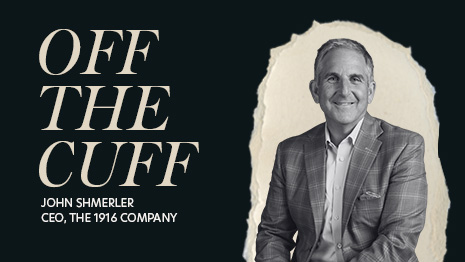
 John Shmerler is CEO of The 1916 Company
 “Off the Cuff” is a Q&A series from Luxury Daily exploring the career paths, current projects and next steps of those shaping the world’s best luxury brands.
The interviews feature a Proust-style twist, allowing readers to get to know industry leaders on a personal level. This edition features John Shmerler, CEO of luxury watch and jewelry retailer The 1916 Company.
In this Q&A, Mr. Shmerler discusses life lessons learned through sport, focusing on meaning rather than transactions and the simple luxuries that money can't buy.
Here is the dialogue:
What was your first job ever? What did it teach you?
I had my first job at 13 years old. I was an accomplished junior golfer and took a job working at a local public golf course. I helped in the pro shop, the cart barn and on the driving range.
It taught me the fundamentals that still guide me today: keep a schedule, show up on time, work the early hours, be a reliable teammate and pay attention to the details. Those lessons have stayed with me throughout my career and shape my leadership as a CEO.
Which skills have been critical to your success? Did you gain these skills within or outside of the workplace?
The skills that matter most to me are fairness, practicality and clear communication. I believe in dealing with the hard things first and approaching leadership through a lens of consistency and accountability.
I learned these skills from years of work experience and from playing competitive sports growing up – both teach you how to show up, contribute and stay level-headed when it counts.
What is the best piece of advice you’ve ever received?
View every action through the “test of embarrassment.” If you imagine your words or actions being described to your parents, a loved one or someone you respect – and you’d be embarrassed – then you should rethink that choice.
It’s a simple filter, but an effective, lifelong compass.
How has your field changed since you started out in luxury, and what do you think the industry will look like in a decade?
In recent years, the economics surrounding the luxury consumer have evolved. The traditional assumptions about what drives demand – or what even defines the luxury customer – don’t fully apply anymore.
Transparency, pricing visibility and global access have reshaped how people discover, evaluate and engage with luxury. Clients today are more informed, more decisive and often more resilient in their purchasing power.
It’s changed the playbook for what resonates.
Clients now expect knowledge, engagement and a sense of community just as much as they expect exceptional product. Retailers who invest in education, service and long-term relationships – not just transactions – will define the next decade.
What recent projects have ignited your passion for working in luxury?
I’m energized by the projects that build bridges across the luxury ecosystem, especially the work we’re doing to formally integrate the primary and secondary markets in a seamless, transparent way.
Creating a client experience that spans new and pre-owned watches and jewelry, certified pre-owned watches and now pre-owned handbags is both challenging and incredibly rewarding.
By truly listening to what our clients want – developing our team, working closely with our brand partners, focusing on the experience, the education and all of the details that sit adjacent to the actual products themselves – we’re able to shape the future of how people collect.
That’s what energizes me.
Who, in any industry or sphere, would you most like to share a long lunch with — and where would you take them?
Warren Buffett. I’d take him for a hamburger and a Coca-Cola in Omaha.
I’d want to hear his stories about investing, discipline and identifying the things that truly resonated with him over time. His clarity of thought and long-term perspective are unmatched.
How do you get into the right mindset before a big meeting or presentation?
I don’t believe in “rising to the occasion.” You fall back on your training. If you’re prepared and you operate with consistency every day, then the big moments don’t require a different mindset; you’re already in it.
As a CEO, you often don’t know when those moments will arise. Someone may need clarity, grounding or direction at any time. So I try to stay present, fully engaged and ready to give people my full attention.
The immediacy of modern communication makes that even more important. We built systems that encourage instant replies: texts, chats, emails, dashboards, constant pings. But the truth is, as a leader today, you don’t have time to “get into” a mindset. If you’re not already there, you’re in trouble.
On your days off, what can you be found doing to relax or have some fun?
I’m usually training for something – something athletic or something for my mind or body.
I’m running the half marathon in a few weeks. I play a lot of golf and work at it. I meditate daily and I read the Torah portion in English each week, making my way through the Bible each year.
Beyond that, I don’t spend much idle time. I’ve worked six days a week since I was 13 years old, and that rhythm has always felt natural to me.
What does luxury mean to you?
To me, luxury isn’t about objects. It’s fulfillment, comfort in your own skin and having meaningful relationships.
I live well, but I’m not a big consumer of “luxury” in the traditional sense. The real luxury in my life is having purpose, stability and a family I enjoy spending time with. You can’t buy that.
Whether a product or service/experience, what is your favorite luxury indulgence?
My favorite luxury indulgence is designing and building our stores. They’re beautiful, thoughtful environments meant for others to enjoy. Creating spaces that inspire people – that’s a privilege.
And while I’m invited to countless luxury events every year, I rarely attend. I don’t seek luxury for myself; I’d rather create it for the communities we serve.